
How Insurance Companies Handle Car Accident Liability Disputes
Nov. 6, 2026
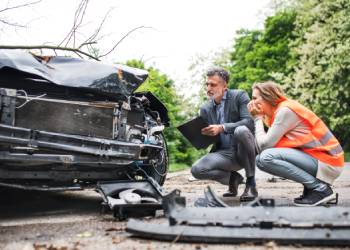 After a car crash, the biggest fight is often not whether there is insurance, but who caused the car wreck. Insurance companies handle car accident liability disputes by investigating the facts, comparing each driver’s actions to Oklahoma fault rules, and deciding whether to accept, deny, or split responsibility. That process matters because a liability decision can reduce or block payment, especially if the insurer claims you were partly at fault.
In Oklahoma City, Edmond, Mustang, Yukon, Moore, Norman, and throughout the state, Justin Lowe & Associates helps people deal with disputed fault after car accidents. When an insurer says the other driver isn't fully responsible, or tries to shift blame to you, early legal guidance can help protect evidence, preserve your claim, and keep you from saying something that weakens your position. Schedule a complimentary consultation today to get comprehensive legal counsel from an experience auto accident injury attorney.
What Insurance Adjusters Look at First
When liability is disputed, the insurance adjuster usually starts with the basic evidence from the scene. That often includes the police report, driver statements, passenger statements, photographs, vehicle damage, video footage, and the location of the impact. The insurer may also review road conditions, weather, skid marks, and whether either driver received a traffic citation.
The goal is not simply to learn what happened. The insurer is deciding whether its policyholder caused the crash, whether another driver shares fault, and how much money the company may have to pay. In practice, that means adjusters often look for facts that support limiting the claim.
For example, if one driver was rear-ended, that may appear straightforward at first. But the insurer may still ask whether the lead driver stopped suddenly, had nonworking brake lights, or made an unsafe lane change just before impact. Liability disputes often turn on those smaller details.
Oklahoma Uses a Modified Comparative Negligence Rule
Oklahoma follows a modified comparative negligence rule. Under Oklahoma’s comparative negligence law, an injured person can recover damages only if that person’s negligence is of less degree than the negligence of the other party. If the injured person is 51% or more at fault, recovery is barred. If the person is 50% or less at fault, damages are reduced by that percentage.
That rule shapes how insurers handle nearly every disputed car accident claim. If an insurer can argue that you were partly responsible, it may reduce the value of your claim. If it can push your share of fault above 50%, it may deny the claim entirely.
In practical terms, liability disputes are often really disputes over percentages. An insurer may not need to prove that you caused the whole crash. It may only need enough evidence to argue that you contributed to it in a way that lowers what it must pay.
Why Insurance Companies Dispute Fault
Insurance companies do not treat every accident as a clear yes-or-no question. They may dispute liability for several reasons:
The drivers give conflicting stories.
There are no independent witnesses.
The police report is incomplete or inconclusive.
The crash involves multiple vehicles.
The damage pattern does not match one side’s version of events.
The insurer believes your actions contributed to the collision.
Common allegations include speeding, distracted driving, following too closely, failing to yield, unsafe lane changes, and ignoring traffic signals. Even when the other driver was cited, that does not automatically end the dispute. A traffic citation can be important evidence, but insurers still conduct their own review.
This is one reason disputed liability cases can become more complicated than many people expect. A claim that seemed obvious at the scene may later turn into a debate over sequence, timing, visibility, and driver conduct.
What Evidence Can Strengthen Your Position
The strongest liability cases usually rely on objective evidence. That means evidence that does not depend only on one driver’s memory after a sudden event. Helpful evidence may include dashcam footage, surveillance video from nearby businesses, black-box data, photographs showing vehicle position and damage, and early witness statements.
Medical records can also matter in a liability dispute, especially when they help confirm the force and direction of impact. In some cases, accident reconstruction may help if the insurer makes a technical argument about speed, braking, or lane position.
If fault is being contested, preserving evidence quickly can make a real difference. Video may be deleted, vehicles may be repaired, and witnesses may become harder to reach. That is often when a personal injury claim becomes more than a paperwork issue and turns into a factual investigation.
When Legal Help May Be Especially Useful
Some liability disputes can be resolved through additional documents or clearer evidence. Others become more serious when the insurer denies fault, assigns you an unfair percentage of blame, or refuses to negotiate from a reasonable position.
Legal help may be especially useful when:
The insurer says you were partly or mostly at fault.
Multiple vehicles were involved or witness accounts conflict.
A serious injury makes the claim value significant.
Important evidence needs to be preserved quickly.
The insurer is delaying while the filing deadline approaches.
A recorded statement or prior communication may be used against you.
In those situations, the dispute is no longer only about what happened on the road. It is also about how the evidence is framed, presented, and challenged.
Get Comprehensive Legal Representation in Oklahoma
Liability disputes often come down to details that are easy to miss in the days after a crash. Justin Lowe of Justin Lowe & Associates represents injured people in Oklahoma City, Edmond, Mustang, Yukon, Moore, Norman, and throughout the state of Oklahoma in auto accident injuries, including car accident cases where insurers dispute fault.
Attorney Lowe is an Oklahoma native who was born in Mustang, Oklahoma. He is ready and willing to assist you with your auto accident claim and litigation.
For people looking into Oklahoma City personal injury representation, Justin Lowe & Associates offers complimentary consultations. If an insurance company is questioning liability after a car crash, the next step may be to have the facts reviewed before the insurer’s version of events becomes the one that controls the claim.